When Does Wasp Season Start and End in the UK?
In the UK, wasp season starts in April when hibernating queens wake up, peaks between July and August when colonies hit thousands of workers, and ends by late October or the first hard frost of November. Here is what happens inside your loft or roofline month by month, why wasps turn nasty in late summer, and when a nest actually needs treating.
Quick Summary: What You Need to Know Right Now
- Start of season (April – May): Queen wasps wake from hibernation and build golf-ball-sized starter nests.
- Peak activity (June – August): Worker numbers swell from a few hundred to up to 10,000. You will spot steady flight lines going in and out of roof tiles, air bricks, or soffits.
- Aggressive stage (Late August – September): The queen stops laying eggs. Workers lose their food supply inside the nest, binge on fermenting fruit and sugary drinks outdoors, and sting with very little provocation.
- End of season (October – November): Colder nights and lack of food kill off the old queen and all the workers. Mild autumns can drag activity into November.
- Old nests: Wasps never reuse an old paper nest the following year.
The Annual Wasp Colony Timeline
When we get called out to inspect a property, the time of year tells us almost everything about what we are walking into. Dealing with a sluggish queen in April is a completely different job to treating a basketball-sized paper nest packed with thousands of defensive workers in August.
Both Common Wasps (Vespula vulgaris) and German Wasps (Vespula germanica) follow the same strict annual calendar across the UK.
1. Spring: Queen Emergence (April to May)
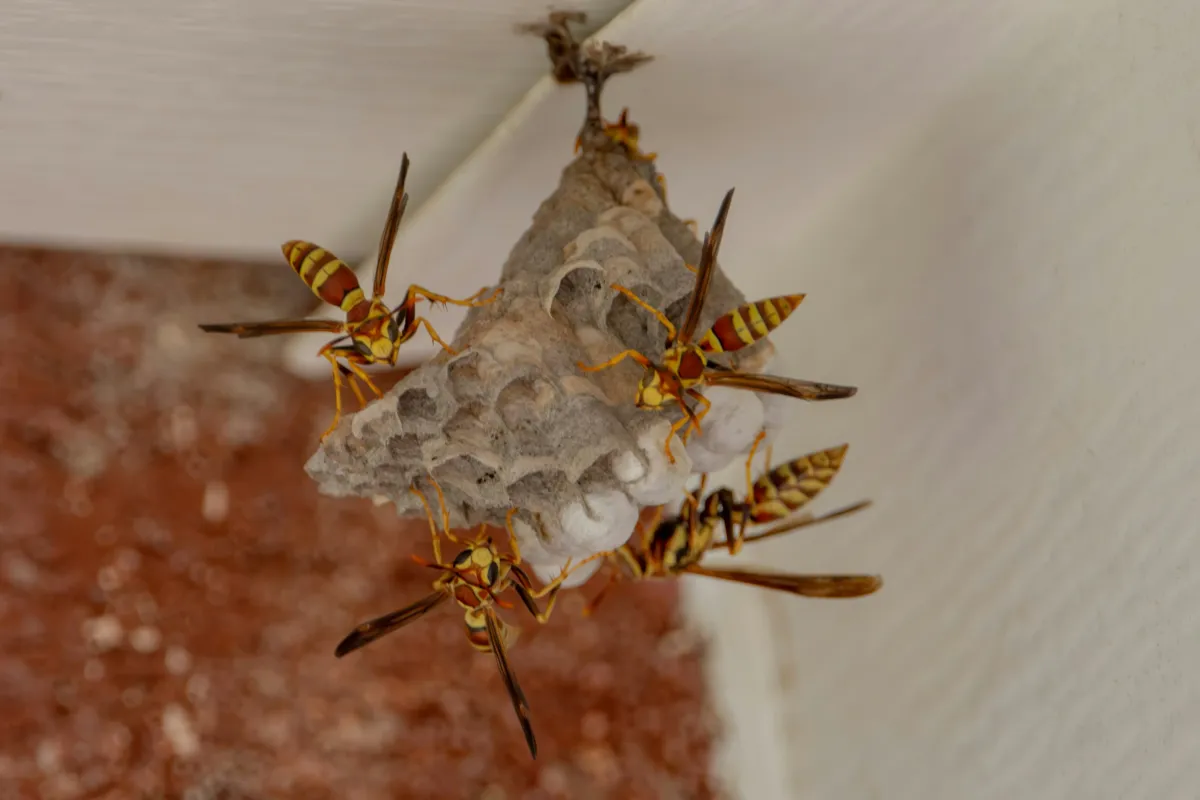
Low RiskAs daytime temperatures climb past 10°C in April, fertilised queen wasps wake up from winter hibernation. You will often find a large, slow-moving wasp buzzing heavily against a bedroom window or conservatory glass—she has likely spent the winter tucked inside your loft insulation, behind heavy curtains, or under loose roof felt, and is now trying to get outside.
Once outside, she scrapes tiny shavings of weathered wood from garden fences, sheds, or decking. Mixing this timber pulp with her saliva, she builds a walnut-sized paper dome in a dry, dark void and lays her first batch of 10 to 20 eggs.
2. Early Summer: Colony Expansion (June to July)
Moderate RiskThe first batch of sterile female worker wasps hatches in June. They immediately take over all building and foraging duties, allowing the queen to stay inside the nest laying up to 200 eggs a day.
During June and July, workers are single-minded. They are hunting caterpillars, flies, and spiders to chew up and feed to the growing grubs inside the nest. In return, the grubs secrete a sugary liquid that feeds the adult workers. Because the workers have a steady food source at home, they rarely bother people sitting in the garden unless you accidentally step on a ground nest or block their flight path into the eaves.
3. Late Summer: Peak Numbers & High Aggression (August to September)
High RiskBy August, a mature nest in a loft space can hold between 5,000 and 10,000 wasps. At this point, the colony produces fertile males (drones) and next year's queens. Once those final eggs are laid and the larvae pupate, the grubs stop producing the sugary liquid the workers rely on.
Suddenly, thousands of unemployed, starving worker wasps are kicked out of the nest hierarchy to scavenge for neat sugar. This is why wasps ruin outdoor meals and beer gardens in late August and September. They feed on rotting windfall apples and plums, which often ferment in the late summer heat, leaving the wasps disorientated, erratic, and quick to sting.
4. Autumn & Winter: Colony Collapse (October to November)
Declining RiskOnce the new queens fly off to mate and find a winter hiding spot, the original nest begins to collapse. The founding queen dies of old age, and the remaining workers and males die off as night-time temperatures drop and outdoor food vanishes.
However, inside a warm, well-insulated modern loft or behind a cavity wall next to a central heating boiler flue, a colony can easily survive well into November. At this stage of the year, starving wasps often follow the warmth and light downwards—crawling through ceiling spotlight fittings, loft hatches, or extractor fan ducts directly into bedrooms and bathrooms.
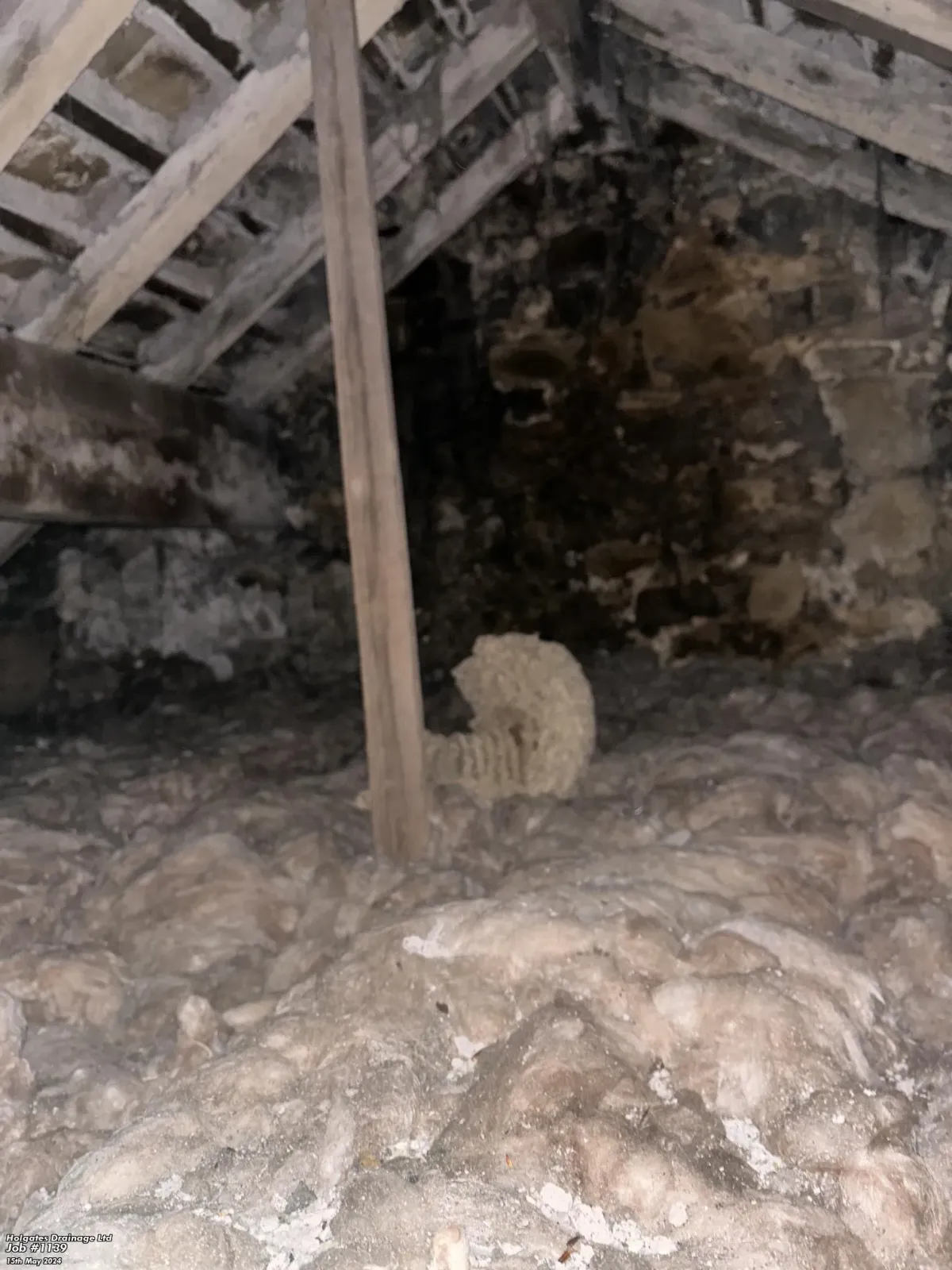
A mature late-summer paper nest built amongst fibreglass loft insulation.
Why Late-Season Nests Cause Internal Ceiling Damage
When a nest is built tight against a plasterboard ceiling inside a loft space or eaves cupboard, the wasps continuously expand the outer paper envelope.
By late August, it is very common for workers to chew clean through the plasterboard from above. Homeowners often notice a damp-looking brown stain or hear a loud, dry scratching noise right above their bed just before dozens of wasps break through into the room.
Do Wasps Reuse Old Nests Next Year?
No. Unlike honeybees, a wasp colony never reuses a previous year's paper nest. Once the workers and the old queen die off in late autumn, the fragile chewed-wood structure is abandoned for good.
If you climb into your loft in January and spot a grey, swirled paper ball hanging from the rafters, it is almost certainly empty and harmless. You do not even need to cut it down unless it is in your way—in fact, leaving an old dormant nest in place doesn't stop new queens entering the roof, nor does it act as a territory deterrent (despite the popular myth about hanging fake paper bags).
The catch: While wasps will not move back into the exact same paper structure, a sheltered loft space with a gap in the mortar under the ridge tiles or an unmeshed cast-iron air brick is prime real estate. New queens emerging the following spring will follow the same warm air currents and often build a brand-new nest right next to last year's old one.
Why You Should Never Block a Wasp Entrance Hole
One of the biggest mistakes we see on call-outs across Lancashire—whether on stone-built terraces in Darwen with deep rubble wall cavities or newer timber-frame estates around Chorley—is a homeowner squirting expanding foam or silicone sealant into the outside hole where wasps are flying in and out.
Blocking the outside entry point does not suffocate or starve the nest. Instead, you trap thousands of agitated workers inside your wall cavity or roof void, and you block hundreds of returning foragers on the outside.
The trapped wasps inside will immediately chew towards the nearest source of light or air to get out. Nine times out of ten, that means chewing through plasterboard, squeezing past radiator pipe collars, or pouring out of ceiling rose light fittings straight into your living room. Never seal an entry point until a professional insecticidal treatment has completely killed off the colony.
How We Treat Active Nests Safely at Any Stage of the Season
Shop-bought aerosol cans require you to stand within a couple of metres of the nest, and they lack the pressure to reach colonies hidden three feet back behind a soffit board or under roof tiles. When a nest is disturbed by a weak spray, the guard wasps release an alarm pheromone that triggers the entire colony to attack whatever is moving nearby.
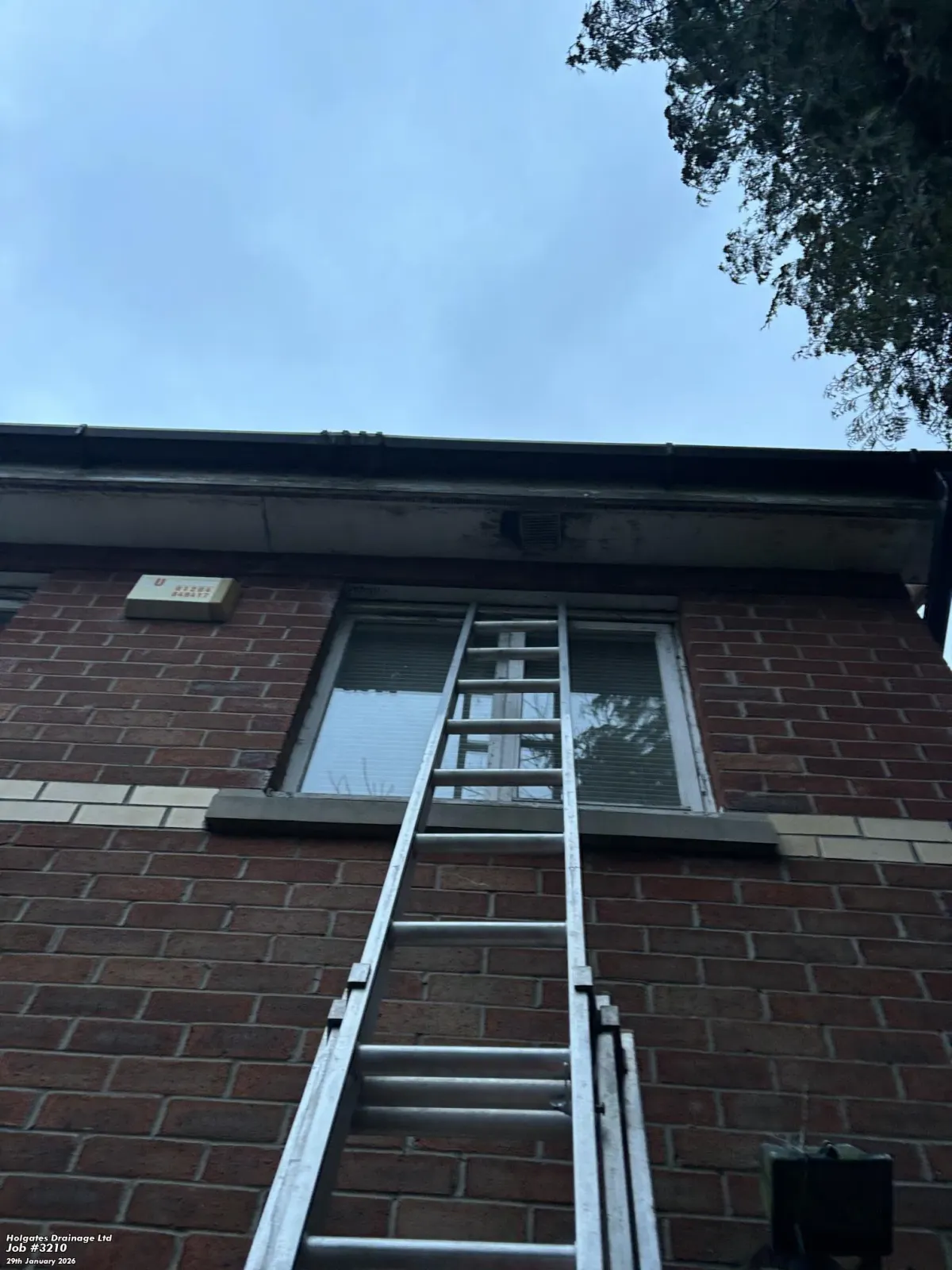
When our CPCA-accredited technicians attend your property, we do not need to tear down fascia boards or erect scaffolding. After checking the flight lines from ground level and making sure children and pets are safely indoors with windows shut, we use either triple-extension ladders or telescopic carbon-fibre lances that reach up to two- and three-storey rooflines from the ground.
We inject a high-pressure, professional-grade insecticidal dust directly into the entrance point or the heart of the nest. As returning foraging wasps land and crawl through the entrance tunnel, the dust sticks to their bodies and legs, and they carry it deep inside to the queen and the brood. Within 2 to 4 hours, activity drops sharply, and within 24 hours the entire colony is dead.
Related Services & Guides
Practical pest advice and professional eradication services from our local team.
Wasp Nest Removal in Blackburn
Professional wasp nest removal in Blackburn. Same-day treatments for homes and businesses. Safe, effective eradication by CPCA accredited technicians.
How Much Does Pest Control Cost in the UK?
Find out what affects UK pest control prices, from council call-outs to private treatments, follow-up visits, and permanent entry-point proofing.
Are Pest Control Treatments Safe for Pets?
Find out how professional pest technicians protect dogs, cats, and children using lockable bait boxes, HSE-approved sprays, and safe drying times.
How Do Rats Get Into Houses Through Drains?
Find out how brown rats use broken clay pipes and missing drain bungs to enter cavity walls, and when a CCTV survey and rat blocker will stop them.
How to Tell if You Have Rats or Mice Under Floorboards
Hearing noises beneath the floor? Learn how to tell rats and mice apart using practical signs like dropping size, scratching sounds, and greasy rub marks.
Why Do Shop-Bought Mouse Traps and Poisons Fail?
Find out why DIY mouse traps and hardware-store poisons rarely clear a terrace house infestation, and why sealing 5mm entry gaps is the real fix.
What Are the UK Laws on Trapping Grey Squirrels?
Learn the UK legal rules on trapping invasive grey squirrels, why live release is illegal, and how to check for protected bats before starting loft work.
How Much Damage Can Squirrels Do in a Loft?
Learn what damage grey squirrels cause inside roof spaces, from chewed electrical wiring and torn loft insulation to gnawed roof timbers and soffits.
Why Should You Never Block Up a Wasp Nest Hole?
Blocking an active wasp hole with silicone or foam forces angry wasps to chew through internal plasterboard. Learn how professional lance treatments work.
How Do You Prepare a Room for Bed Bug Treatment?
Learn how to prepare your rooms before a professional bed bug visit, including how to bag laundry safely and clear furniture without spreading eggs.
How to Spot Cockroaches Behind Kitchen Appliances
Learn how to check behind fridges, dishwashers, and kickboards for cockroach droppings, egg cases, and musty smells in your home or commercial kitchen.
Why Am I Still Seeing Fleas After a Room Spray?
Learn why dormant flea cocoons hatch days after a professional spray, how long full eradication takes, and why you must wait to vacuum.
Bird Spikes vs Tensioned Wire: Which Works Best?
Compare stainless steel bird spikes and tensioned wire systems. Learn how bird species, roosting pressure, and ledge styles determine the right deterrent.
Does Bird Proofing Void Your Solar Panel Warranty?
Find out how professional non-penetrating solar clips secure bird mesh without drilling into your panels, keeping your manufacturer warranty fully valid.
Can Pigeons Under Solar Panels Cause Bird Mites Inside?
Learn how pigeons nesting under solar panels bring biting bird mites into upstairs bedrooms, and why nest removal and sanitisation must happen with meshing.
Why Is Cleaning Dried Pigeon Droppings Yourself Risky?
Learn why sweeping dry pigeon guano in lofts or on balconies releases harmful airborne spores, and how biocide damping down keeps your home safe.
Do Small Businesses Need a Pest Control Contract?
Weigh up one-off emergency call-outs against routine pest control contracts. Learn how regular checks catch drain defects and insects before stock is ruined.
How Many Visits Does Mouse Control Take?
Find out why clearing a mouse infestation usually takes 2 to 3 visits, from checking tamper-resistant bait boxes to sealing 5mm entry gaps with copper mesh.
Do Bed Bugs Mean Throwing Your Mattress Away?
Learn why dumping a mattress with bed bugs often spreads eggs through your home, and how professional heat and seam treatments save your furniture.
German vs Oriental Cockroaches: What Is the Difference?
Learn how to tell German and Oriental cockroaches apart, from warm appliance motors to damp cellar drains, and why species matters for eradication.
How Do Pest Technicians Work Discreetly in Shops?
See how commercial pest technicians manage inspections, hidden bait stations, and out-of-hours treatments in shops and restaurants without alarming customers.
What Happens if a House Survey Finds Woodworm?
Found woodworm on a house survey? Learn how we check for active beetles, test timber moisture, and treat loft rafters or joists to satisfy lenders.
Why Do Silverfish Gather in Bathrooms and Kitchens?
Find out why damp plaster, leaky pipes, and high humidity attract silverfish and beetles, plus practical steps to seal gaps and clear infestations.
Need a Wasp Nest Sorted Today?
Speak directly to a local technician in Ramsgreave, Blackburn. We respond to standard enquiries within four hours and offer 24/7 emergency cover for severe stings or indoor swarms.